
Easter 2026
Easter 2026
Armon Nakprasert
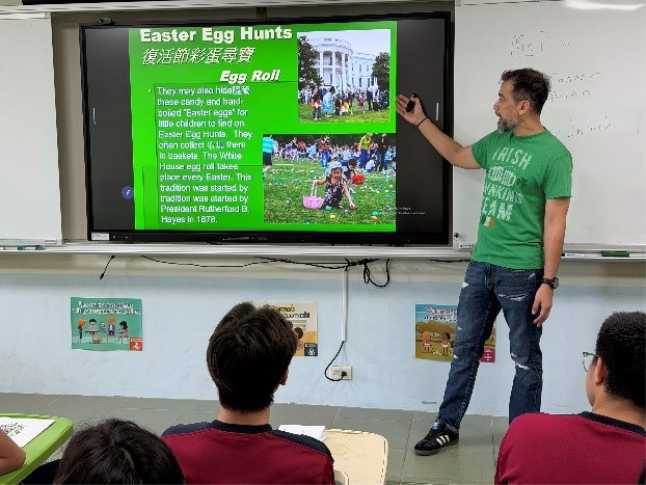
Every spring, to help Huey Deng students learn both language and culture, I teach a lesson about Easter. Although Easter is traditionally a Christian holiday, my classes focus on its history, modern customs, and the secular traditions that many people, including myself, experienced while growing up.
Easter has a long history that began as a Christian celebration of the res-urrection of Jesus Christ. Over time, however, many of its symbols and traditions became more widely shared across cultures. For example, eggs have been used for centuries as a symbol of new life and rebirth, which connects with the idea of spring and renewal. Today, even in places where Christianity is not the main religion, Easter is often celebrated in simple and enjoyable ways.
In modern times, Easter is commonly associated with colorful eggs, chocolate, and family activities. One of the most popular traditions is egg decorating, also known as dyeing eggs. I remembered the first time I dyed eggs with my mom. We bought an egg dyeing kit from the supermarket and a dozen eggs. It was fun watching the pastel dye transform the eggs into spring colors. However, when we were done, my mom told me to get started on eating the eggs. My reaction was of shock and disappointment considering I do not like hard-boiled eggs. From then on, Easter egg dyeing was never my thing.
Another well-known Easter tradition is receiving a candy basket. As a child, this was always one of my favorite parts of the holiday. I remember waking up excited to find a basket filled with chocolates, jelly beans, and small toys. The idea of the “Easter Bunny” delivering these treats added a sense of fun and imagination to the celebration. While this tradition is not religious, it has become an important part of how many families enjoy Easter today.
In my classes, Easter activities provide a way to connect global traditions with local learning. Many students may not have experienced Easter before, so talking about dyeing eggs and candy baskets helps them understand how holidays can be both cultural and fun. It also shows that learning English is not only about grammar and tests, but also about exploring different ways of life.
Overall, our Easter activity was a great success. I hope my students were engaged, curious, and excited to participate. By combining history, modern practices, and personal experiences, we created a lesson that was both educational and enjoyable. Activities like these remind us that language learning can be meaningful when it connects to real-world traditions and shared human experiences.
202 王宸宇
We had a lot of fun learning about Easter. First, we played Kahoot to practice English Easter vocabulary, which was very exciting! We also learned new words like "cross" and "daffodil." Finally, I worked with my classmates to write a simple poem, with each line starting with the letters E, A, S, T, E, and R. We shared our ideas and helped one another throughout the process. This activity reminded us that learning English can be both easy and fun when we play games and work together as a class.
301 徐以恩
In Teacher Fredrik's class, we learned a great deal of vocabulary related to Easter and participated in many enjoyable games throughout our lessons. I found the classes to be both entertaining and highly educational. Not only were they a lot of fun, but I also gained a deeper understanding of the origins and traditions of Easter, which made the experience even more meaningful and memorable.
302 鄭煜璁
Though Easter is deeply meaningful for people in the West, most people in the East do not celebrate it, as their religions and cultures are quite different. Every April, most Western people paint eggs or gather for big family meals, while people in the East typically observe traditions like tomb sweeping. Thanks to globalization, however, we can all learn about and enjoy the spirit of Easter, even if we are not in the West or in Jerusalem.
Mr. Johansson began by teaching us the vocabulary, events, and foods associated with Easter. Through the pictures he showed us, it felt almost as if we were experiencing a real Easter festival. We also learned some fascinating facts-for example, in Sweden, people use millions of eggs every day during Easter, either for painting or cooking. That surprised me, because I had always assumed people painted on plastic balls. It turns out they are real eggs, laid by hens!
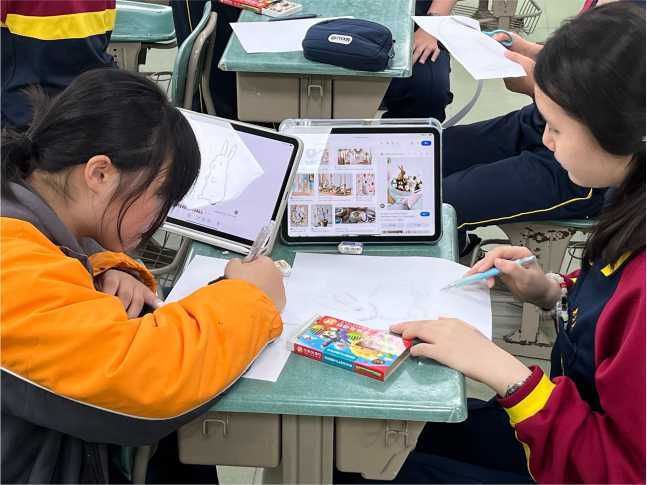
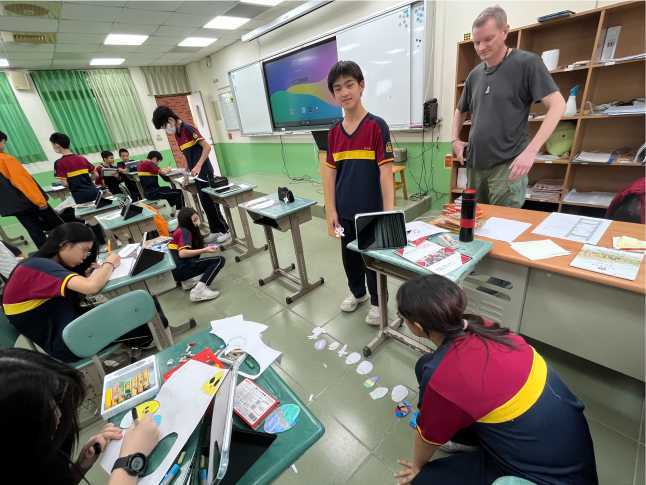
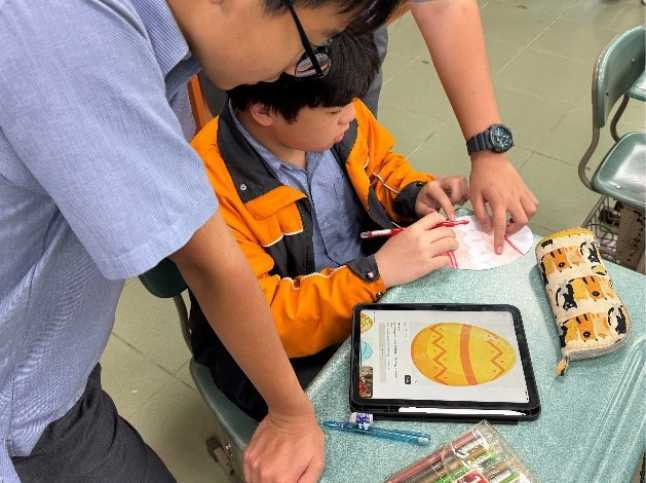
Later, Mr. Johansson had us start painting. Although he didn't give us real eggs or even plastic ones, he gave each of us a piece of paper to draw any character or item associated with Easter. Some students drew eggs, some drew bunnies, and I drew Peter Rabbit. It had been a long time since I had drawn anything with a festive theme, especially for Easter. As I kept drawing, I could almost feel Peter coming to life — awakening, just like the spirit of Easter itself.
When I finished my picture, I added it to my classmates' drawings to create an Easter bunting together. It looked fantastic! All the designs were beautiful and cute, like bunnies, eggs, and chicks running across a grassy field. Even though we didn't have an Easter dinner or go egg hunting, I could almost feel the joy of it all.
